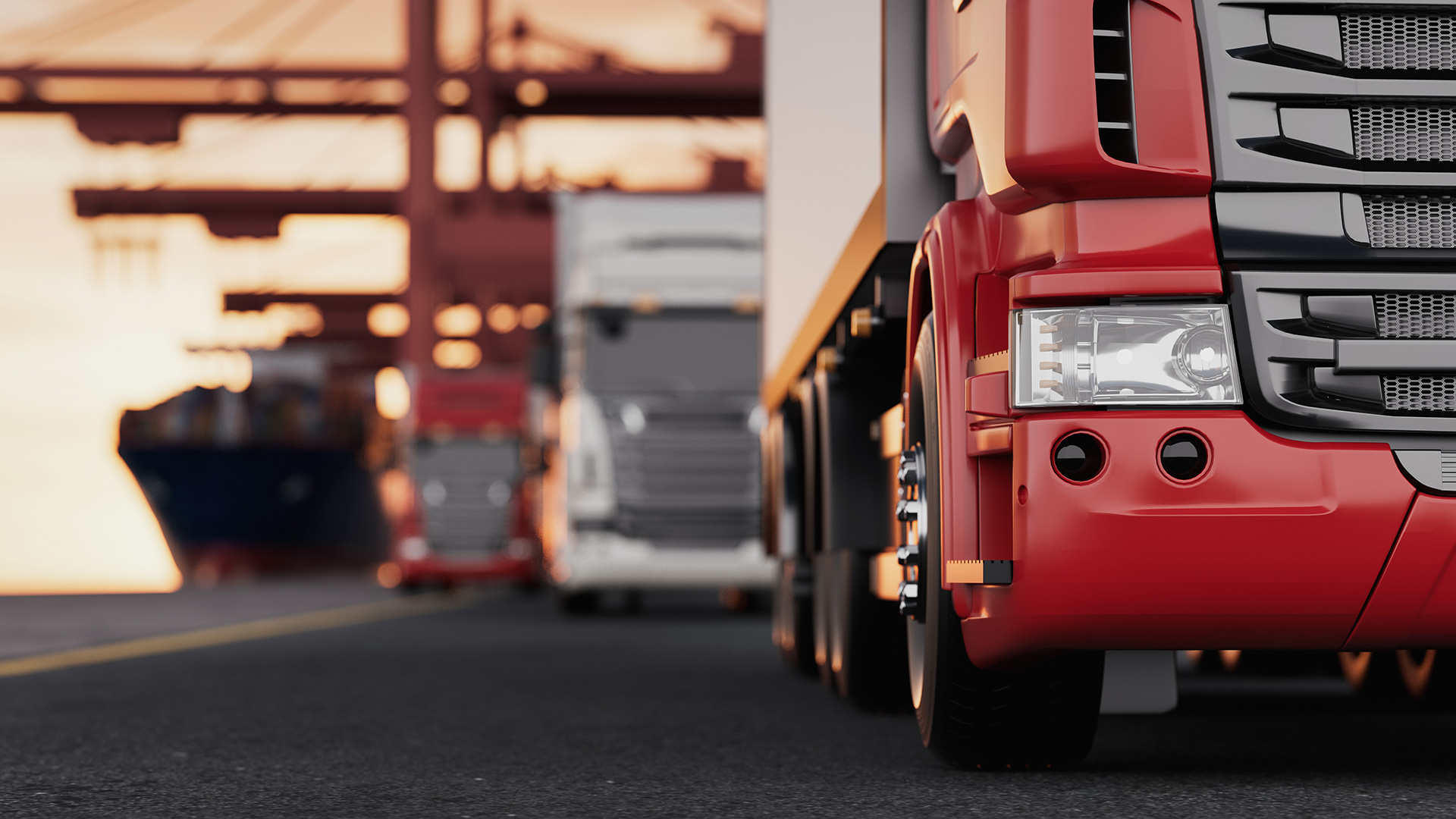
 Partial transport – also known as LTL (Less Than Truckload) – is a transport service in which one lorry picks up loads from several different senders. Each customer uses part of the loading space, paying only for the space that is actually occupied.
This makes LTL a good solution for companies that:
- do not have a full load for an entire trailer,
- want to optimise transport costs,
- need to transport goods in a timely manner, but not necessarily by express delivery.
LTL transport is used in domestic and international logistics. It works particularly well in trade, e-commerce, wholesale distribution and for manufacturers who regularly ship smaller batches of goods.
What is less than truckload transport?
Less Than Truckload transport involves one vehicle transporting loads from several different customers. Each sender uses only part of the cargo space and pays only for the space occupied by their goods. The rest of the vehicle is filled with other shipments going in a similar direction.
This solution works well when:
- there is no need to reserve an entire trailer,
- the load does not exceed a few pallets,
- cost optimisation is more important than express delivery.
In the LTL model, route planning is more complex – each shipment must be properly consolidated, secured and unloaded at a specific location. But for the sender, everything is simple: the goods are picked up, transported according to plan and delivered to the recipient without the need to organise an entire vehicle.
Partial transport is often used in domestic and international logistics. The solution is used, among others, by trading companies, distributors, e-commerce and manufacturers who regularly ship smaller batches of goods.
Advantages of less than truckload (LTL) transport
Less than truckload transport is a solution for companies that do not need an entire trailer but want to transport goods quickly, safely and at a reasonable price. Below are the most important benefits you gain by choosing the LTL model.
You only pay for the space you use
In less than truckload transport, the cost of transport is shared between several shippers. So you pay proportionally – for the metres of space or number of pallets that your goods actually occupy. This is a real saving for smaller loads.
More frequent shipments
You don’t have to wait until you fill an entire vehicle. You can send goods in smaller batches – regularly or when needed. This facilitates inventory management and speeds up goods turnover.
Example:
An online store sends pallets with new goods to collection points in several provinces. Thanks to LTL, it can do this every few days – without storage and without the risk of products expiring.
Less organisational burden
You do not have to organise the entire transport, vehicle or complex logistics yourself. We take care of consolidation, route selection and load securing. The customer delivers the goods – we take care of the rest.
Access to multiple routes and destinations
Thanks to our LTL transport network, we are able to handle various routes – domestic and international. Whether you are shipping to Silesia, Mazovia, Germany or the Czech Republic – we have ready-made solutions.
Safe transport despite vehicle sharing
Each load is secured individually. We plan the layout of the trailer so that the goods are not exposed to damage. The goods travel exactly as far as they need to.
What goods are most often transported in the partial transport model?
Partial transport (LTL) is best suited for transporting goods that do not require the entire space of a semi-trailer, but must be delivered efficiently and safely. This solution is used in many industries – from trade to manufacturing.
Goods on pallets
The most commonly transported loads are packed on Euro pallets – from 1 to 10 pieces. These can be finished products, components, semi-finished products, packaging, equipment, building materials or shop fittings.
Cardboard and parcel shipments
Shipments in cardboard boxes – single or stacked on a pallet – are commonplace in the LTL model. This is particularly true in the e-commerce, consumer electronics/household appliances, industrial and office supplies industries.
Goods with non-standard dimensions
We also transport loads that do not fit into the classic pallet format but do not require an entire vehicle – e.g. structural elements, long profiles, bulk packaging, displays.
Food products and dry FMCG goods
Food industry companies often use LTL transport for deliveries to wholesalers, retail chains and catering outlets. This mainly applies to dry products or bulk packaging.
Spare parts and components for industry
Shipments from production plants to partners, service centres and branches – often in small quantities, but at a steady pace. LTL transport allows for quick and regular replenishment of stock.
When is it worth choosing partial transport instead of full truckload transport?
Partial transport (LTL) is cost-effective when the load does not take up the entire space of the trailer and the delivery time does not have to be immediate. It is a solution between groupage and full truckload (FTL) transport – flexible, economical and safe.
When you have a smaller load
If your goods fit on a few pallets or take up a small part of the loading space, there is no need to reserve an entire vehicle. With the LTL model, you only pay for the space that your load actually takes up.
Example:
A cosmetics company sends 4 pallets of goods to a wholesaler in another province. A whole semi-trailer is not needed – partial transport reduces the cost of delivery.
When you ship goods regularly, but in small batches
LTL works well for companies that ship frequently – e.g. 2–3 times a week – but in small quantities. It is a good option for e-commerce, chain stores and distributors.
When you want to optimise your logistics costs
Instead of waiting for a full load, you can ship goods on an ongoing basis. You do not incur the costs of empty space and do not risk downtime in the warehouse.
When goods are not time-sensitive
LTL transport rarely takes place directly from point A to point B. The vehicle makes several deliveries along the route, so the journey time may be slightly longer than with full truckload transport. For many companies, this is not a problem if they have a time buffer planned.
Example:
A packaging manufacturer sends components to a contractor in the Czech Republic. The goods are not urgent, but need to arrive within a few days. LTL offers the best price-to-functionality ratio for this company.
Companies and industries for which less-than-truckload transport is a cost-effective solution
Less-than-truckload (LTL) transport is a solution designed for companies that regularly ship goods but not in quantities sufficient to fill an entire trailer. It works well in industries where flexibility, cost predictability and the ability to make frequent deliveries are important.
Manufacturing companies
Factories that ship components, semi-finished products or finished goods on a regular basis – but in small batches. LTL allows them to avoid freezing goods in storage and to ship them on an ongoing basis, depending on demand.
Example:
A furniture manufacturer sends several pallets of chairs once a week to a distributor in another province. Full truckload transport would be unprofitable – partial load works better.
Distributors and wholesalers
Companies that supply multiple collection points. Thanks to LTL, they can deliver to different locations without having to organise full transport for each order.
E-commerce industry
Online shops that ship goods to external warehouses, collection points or parcel locker networks. LTL allows them to plan deliveries according to turnover rather than load volume.
Chemical and packaging industry
Companies in these sectors often ship repetitive batches of goods, such as canisters, PET bottles, films and cartons. Lightweight but bulky goods – ideal for shared space.
Office supplies, cosmetics, FMCG
Industries with regular deliveries to chain stores, showrooms or trading partners. Small volumes but high frequency of shipments – this is where LTL works best.
Companies operating in foreign markets
Exporters and importers who want to test new markets without ordering full transport. LTL allows for flexible planning of deliveries to different countries without incurring high costs.
Jasek Transport – a reliable company with experience in transporting goods in Poland and across the EU
Jasek Transport is a company that has been operating in the transport industry for over a dozen years. We serve customers from various sectors – from manufacturing and trade to logistics and processing. We provide domestic and international transport services, including less than truckload (LTL), full truckload (FTL), specialised cargo and just-in-time deliveries.
What sets us apart?
- Stability and organisation. We handle every order from start to finish – from the initial enquiry to the delivery of the goods. We have an experienced team of freight forwarders who ensure punctuality and communication at every stage.
- Customisation. We do not operate according to a template. We select the route, vehicle and transport solution for each specific order – regardless of whether it is a single pallet or a full load.
- Safety and responsibility. All loads are insured. We work with drivers who are familiar with service standards and know how to secure goods. We do not take risks – we operate precisely and in accordance with agreements.
- Range and availability. Thanks to our network of contacts and available fleet, we serve both large cities and smaller towns. We regularly travel on domestic routes and to the following destinations: Germany, Sweden, Great Britain, the Czech Republic, the Netherlands, Belgium, Austria, France, Slovakia and other EU countries.
Who do we work with?
We work with companies that need transport tailored to the changing pace of production, seasonal sales or a dispersed network of customers. We handle both one-off orders and long-term collaborations.
What does the organisation of partial transport involve?
Good planning is the most important thing in partial transport. The aim is to fit different loads into one trailer, deliver them on time and ensure they do not interfere with each other. For the customer, the whole process looks simple – but before the vehicle sets off, there is a lot going on on our side.
Checking details and matching routes
After receiving an enquiry, we analyse the parameters of the load – dimensions, weight, type of goods and direction of transport. On this basis, we look for a suitable route and space in the cargo area. We always take into account the conditions that the vehicle must meet – e.g. if the goods cannot be combined with other products.
Consolidation of shipments
This is a crucial stage. We arrange transport so that loads from different customers can travel together. We pay attention to route logistics, unloading order and the requirements of individual goods. Thanks to this, each parcel arrives where it should – without delays or unnecessary downtime.
Load securing
Each item is secured according to its specific characteristics. If necessary, we use straps, anti-slip mats, separators or separate loading zones. Nothing is left to chance – the load must arrive in the same condition in which it was handed over.
Confirmations and documents
We take care of the documentation – consignment note, transport order, confirmation of receipt. In international transport, we attach customs and commercial documents, if necessary.
Constant contact
On request, we provide information about the status of transport – by e-mail or telephone. GPS tracking is also available on some routes. The customer knows where their goods are and when they will reach their destination.
How to order partial transport with Jasek Transport?
The ordering process is simple and does not require any complicated formalities. Just send us the basic information about the cargo, and we will take care of the rest.
What information do you need to provide?
- Loading and unloading addresses (with postcodes),
- date of collection,
- type of cargo (e.g. pallets, cartons, bulky items),
- dimensions and weight of the shipment,
- special requirements (e.g. ADR, refrigerated transport, lifts).
What is the rest of the process?
- We receive your enquiry – by email or phone.
- We send you a quote and a proposed date.
- Once you accept, we confirm the order and provide you with the collection details.
- We carry out the transport and keep you informed about the status of your shipment.
No long-term contract is required as we serve both regular customers and one-off orders.
Less Than Truck Load (LTL) – frequently asked questions
How many pallets can I send in a partial load?
As a standard, you can send from 1 to approx. 10–12 Euro pallets in an LTL model. If the load exceeds these values, it is worth comparing the cost with full truckload transport. We will advise you on the optimal solution.
Do I need to organise loading and unloading?
Loading and unloading is the responsibility of the sender and recipient. If you need a vehicle with a lift or additional equipment, please let us know when placing your order – we will select the appropriate set.
What goods can I send by partial transport?
We transport, among other things, pallets with goods, cartons, components, industrial goods, cosmetics, equipment, construction elements and many others. If the load has unusual dimensions, please describe it and we will adjust the route and vehicle.
Can I track my shipment?
Yes, for many domestic and international routes, we offer the option of tracking the vehicle or contacting our operations department. We also notify you of the planned delivery.
How quickly is LTL transport carried out?
We usually deliver domestic shipments within 24–48 hours. In international transport, the delivery time depends on the destination and consolidation of shipments – usually 2 to 5 working days.
Is LTL safe for my goods?
Yes. Each load is properly secured and arranged in accordance with the unloading order. We carry out transport in compliance with safety rules – both in terms of physical safety and documentation.
Do I need to have a contract to order transport?
No. We carry out both one-off orders and ongoing cooperation. In both cases, we guarantee the same standard of service.
What if my goods do not arrive on time?
We plan each order with a time margin, taking into account the route, road conditions and other deliveries on a given route. If there is a risk of delay, we will inform you in advance. We can also offer an alternative, such as express transport.
Will my goods be safe when transported with other goods?
Yes. Loads are physically separated and secured with straps, mats or partitions. Each item is arranged according to the order of delivery, so there is no need to rearrange it. We are responsible for securing and transporting your goods safely.
How are costs calculated?
The price of partial transport depends on: the number of pallets, the weight of the load, the volume occupied and the distance. For non-standard shipments, we also take into account the method of loading and technical requirements. Before placing an order, you will receive a full quote – with no hidden fees.
Do I need to be present during loading or unloading?
No, but it is a good idea to make sure in advance that the person on site (e.g. warehouse employee) has all the necessary information. If special conditions are required (e.g. gate code, contact details for the warehouse keeper), please provide them when placing your order.
Can goods be delivered at a specific time?
Yes, deliveries at specific times are possible – e.g. only in the morning, in the afternoon or within a specified time slot. We inform the driver about this and plan the route so that the deadline is met. However, this requires prior agreement.
Is LTL transport suitable for fragile goods?
Yes, provided that the goods are properly packed and labelled. In addition, we can plan their transport in a separate area of the trailer or in a position that minimises the risk of contact with other loads. It is worth reporting such requirements at the enquiry stage.
Are there any restrictions on parcel dimensions?
Standard shipments are pallets up to 120 × 80 cm, but we also transport goods with non-standard dimensions – longer, taller, irregular. The key is that they can be safely loaded and secured in the vehicle. Send us the dimensions – we will advise you whether LTL is suitable.
Does partial transport also operate abroad?
Yes. We provide LTL transport both in Poland and in EU countries (including Germany, the Czech Republic, Austria, the Netherlands and France). We also handle customs formalities for shipments outside the EU, e.g. to the United Kingdom or Norway.